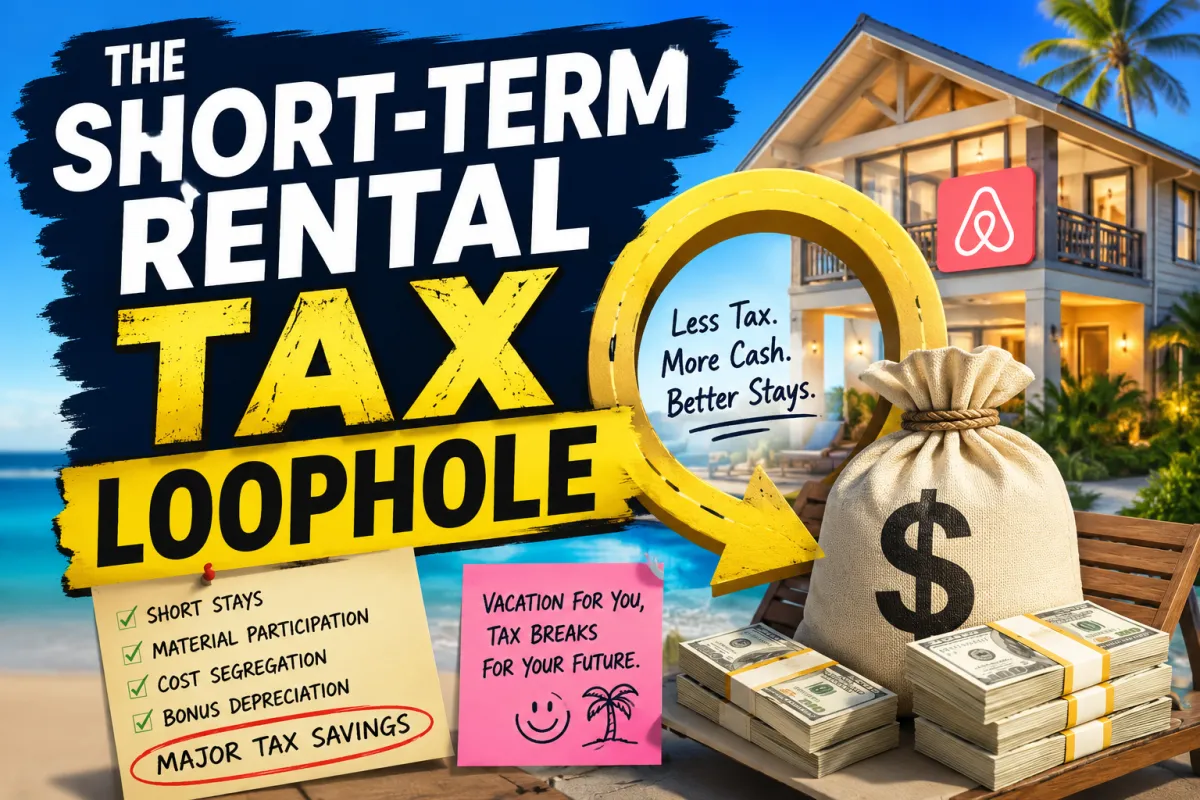
The Short-Term Rental Tax Loophole: How Your Airbnb Could Become Your Favorite Tax Accountant
Imagine buying a vacation rental, hosting a few guests, and then watching your tax bill shrink faster than complimentary hotel shampoo bottles. Welcome to the world of the Short-Term Rental (STR) Tax Loophole—a strategy that has real estate investors grinning wider than someone finding extra fries at the bottom of the bag.
What Exactly Is This Magical Loophole?
In simple terms, the STR tax loophole allows certain real estate investors to use losses from short-term rental properties to reduce ordinary income, including W-2 wages. In other words, your Airbnb might work harder on your taxes than your gym membership works on your fitness goals.
But before you start shopping for beach houses, there are rules.
Rule #1: Guests Can't Stay Forever
To qualify, your property's average guest stay generally needs to be seven days or less. If your guests are treating your Airbnb like a permanent residence, the IRS is not impressed.
Think vacationers, not tenants who know your Wi-Fi password by heart.
Rule #2: You Need to Actually Do Something
The IRS also requires "material participation."
Translation: You can't sit on a yacht while a property manager does everything and then claim all the tax benefits.
Many investors qualify by:
Spending more than 500 hours managing the rental
Doing substantially all the work themselves
Spending over 100 hours and more time than anyone else involved
Basically, the IRS wants proof that you were working, not just refreshing your Airbnb reviews every ten minutes.
The Secret Sauce: Cost Segregation
Here's where things get interesting.
A cost segregation study breaks a property into different components that can be depreciated faster. Instead of waiting decades to claim deductions, investors can accelerate them into the first year.
Imagine buying a $600,000 property and discovering that $180,000 of it can be depreciated immediately.
That's the accounting equivalent of finding a hidden level in a video game.
Example
Property Purchase: $600,000
Cost Seg Study Identifies: $180,000
Bonus Depreciation: $180,000
W-2 Income: $250,000
New Taxable Income: $70,000
The math is simple:
$250,000 income
Minus $180,000 deduction
Equals much happier tax season.
Bonus Depreciation: The IRS's Limited-Time Offer
Bonus depreciation has changed several times over the years.
It went from:
100% through 2022
80% in 2023
60% in 2024
40% in 2025
20% in 2026
But recent legislation restored 100% bonus depreciation for qualifying property acquired after January 19, 2025.
Think of it as the IRS bringing back a popular menu item after customers complained.
Why Do People Call It a Loophole?
Because when the rules were originally written, lawmakers were mostly thinking about hotels and motels.
Then along came Airbnb, VRBO, smartphones, keyless entry, self-check-in, and people willing to rent a treehouse for $400 a night.
The regulations never anticipated millions of ordinary investors operating mini-hotels from their phones. As a result, a perfectly legal tax strategy was born.
Common Mistakes That Make CPAs Cry
1. Misclassifying the Property
Calling something a short-term rental doesn't magically make it one.
The average stay must actually qualify.
2. Forgetting to Track Hours
Nothing says "audit risk" like telling the IRS:
"I worked a lot."
How much?
"Um... a lot."
Keep records.
3. Too Much Personal Use
If you're enjoying the property more than your guests, the tax benefits may start disappearing.
The IRS is surprisingly good at spotting vacation homes disguised as investments.
4. Ignoring Local Regulations
Nothing ruins an investment strategy faster than discovering your city banned short-term rentals six months ago.
Always check local rules first.
Frequently Asked Investor Questions
Can Airbnb Properties Qualify?
Absolutely. As long as they meet the average stay requirement and you materially participate.
Can I Use a Property Manager?
Yes, but be careful. If your property manager spends more time on the property than you do, some participation tests become harder to satisfy.
Can This Loophole Disappear?
Anything is possible in tax law, but there are currently no major proposals aimed at eliminating it.
Final Thoughts
The Short-Term Rental Tax Loophole is one of the most powerful tax strategies available to real estate investors today.
It combines short guest stays, active involvement, cost segregation, and bonus depreciation into a strategy that can dramatically reduce taxable income.
Of course, you'll need a good CPA, careful documentation, and a basic willingness to learn terms that sound like accounting professors invented them.
But for investors willing to do it correctly, the reward can be substantial.
After all, there's something deeply satisfying about having your vacation rental help pay for itself while simultaneously giving your tax bill a much-needed vacation.
Source material adapted from the short-term rental tax loophole explanation and examples.


